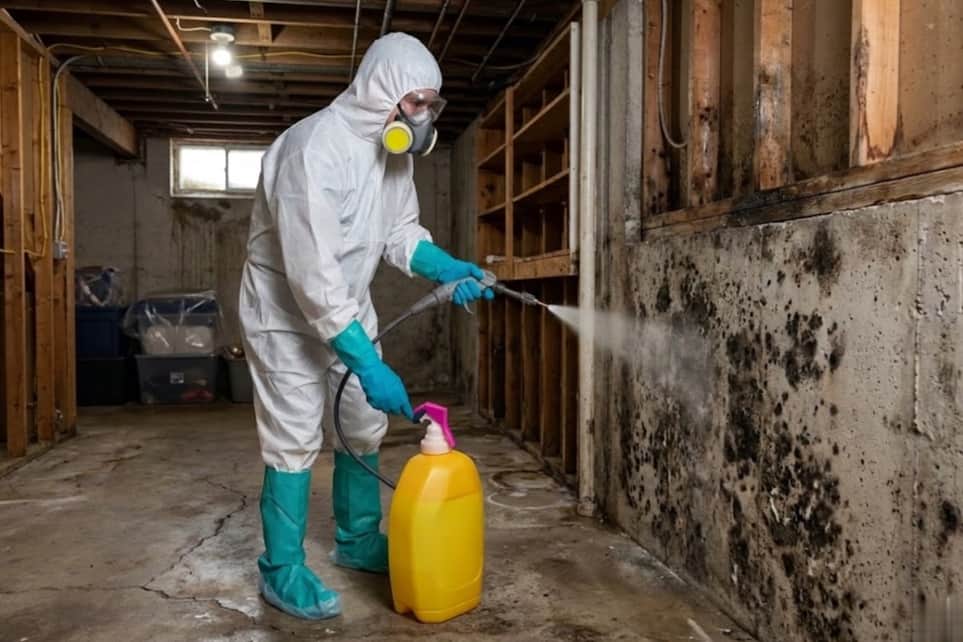
Not every patch of mold requires a professional, and not every job is safe to tackle yourself. We will say that plainly up front, because a lot of mold companies will not. If you have a small spot of surface mold in a well-ventilated room and you know where the moisture came from, you can very likely handle it. The trick is knowing where that line sits, and what changes once you cross it.
A useful starting point is the EPA guideline. In its consumer guidance, the EPA suggests that if the moldy area is less than roughly 10 square feet, about the size of a 3-by-3-foot patch, most people can manage the cleanup themselves. For anything larger, or for growth tied to major water damage, flooding, or sewage, the EPA points homeowners toward a professional who can contain the area and protect the rest of the home. This guide walks through how to read your own situation, why bleach is the wrong tool, and what a professional actually brings to the bigger jobs.
When DIY Is Genuinely Fine
For a small, contained patch of mold on a hard, non-porous surface, such as tile grout, a sink backsplash, or a section of painted trim, do-it-yourself cleanup is a reasonable choice. The EPA suggests scrubbing hard surfaces with detergent and water and then drying them completely. The single most important part is the drying, because mold needs moisture to come back.
Protect yourself while you work. The EPA recommends wearing an N95 respirator, gloves, and eye protection, and ventilating the area so you are not breathing concentrated spores in a closed bathroom. And before you clean anything, find and fix whatever let the moisture in. Wiping mold off a windowsill does nothing if condensation keeps soaking it every winter.
Why Bleach Is Not the Answer
A common DIY mistake is reaching for bleach as a cure-all. The EPA does not recommend the routine use of biocides such as chlorine bleach to clean up mold; under most conditions it is simply not necessary as a standard practice. The deeper issue is that killing mold is not really the goal. According to the EPA, dead mold can still cause allergic reactions in some people, so it has to be physically removed, not just sprayed and left behind.
Bleach also struggles on the materials where mold most often takes hold. On porous surfaces like drywall and wood, the mold sends growth below the surface, so a wipe-down treats the stain you can see while leaving the roots in place. Bleach is mostly water, and that water can soak into the very material you are trying to dry out. The practical takeaway is that remediation means removing the mold and correcting the moisture, not finding a spray that promises to kill it.
The Risks of DIY on Bigger Jobs
Once a job grows beyond that small, contained patch, the risks change in ways that are easy to underestimate.
Spreading spores through the house
Disturbing mold without containment can scatter spores into clean rooms, your HVAC system, and other parts of the home, turning one problem into several. Professionals set up containment barriers and use negative air pressure with HEPA filtration so the spores that get stirred up are captured rather than spread.
Missing the moisture source
If the underlying water problem is not found and fixed, the mold comes back, sometimes within weeks. A roof leak, a failing crawl space vapor barrier, or condensation inside a wall cavity is not something a surface cleaning can solve. Finding the source is often the hardest part of the whole job.
Hidden and structural growth
When mold is inside wall cavities, under flooring, or in insulation, addressing it means opening up and removing affected materials safely, then verifying the result. That is well beyond a weekend project, and it is where the protective equipment, filtration, and careful material handling that keep the process safe are hard to replicate with consumer tools.
What a Professional Actually Adds
A professional mold removal is built around several steps a homeowner cannot easily reproduce:
- Containment to seal off the work area and stop cross-contamination.
- Negative air and HEPA filtration to capture airborne spores during the work.
- Source removal of mold and materials that cannot be cleaned and dried, rather than surface treatment.
- Fixing the moisture source so the conditions that fed the mold are corrected.
- Clearance verification to confirm the space has been returned to normal indoor conditions.
The aim of all of this is not to kill the mold and call it done. It is to remove the growth, correct the water problem, and return the space to a normal condition.
A Simple Way to Decide
Small, surface growth in a well-ventilated area with a known and fixable moisture source is a reasonable DIY candidate. Lean toward professional help if any of the following is true: the area is larger than about 10 square feet, the mold keeps coming back after you clean it, it followed serious water damage or flooding, it is inside walls or your HVAC system, or someone in the home has asthma, allergies, a weakened immune system, or chronic lung disease. The CDC notes those groups are the most sensitive to mold exposure.
Whatever route you choose, fixing the water is the part you cannot skip. As the EPA puts it, the key to mold control is moisture control. If you are unsure where your situation falls, an on-site mold inspection can tell you what you are actually dealing with before you spend money on either a cleanup or a full remediation.