Metro Atlanta
Post-Remediation and Clearance Testing
Independent verification that a remediated area has returned to a normal, healthy condition, documented for your records.
- Inspection that pinpoints the moisture source, not just the mold
- Containment-first work to limit the spread of spores
- A clear written scope and timeline before any work begins
Request an Inspection
Tell us what is going on and we will get right back to you.
Quick answer
Independent verification after remediation, using a visual review and air sampling to document that the area has returned to a normal condition.
Clearance testing, also called post-remediation verification, is how you confirm that a mold job was actually successful. After remediation is finished and the area has been cleaned and dried, a clearance check combines a visual review with air sampling to document that the space has returned to a normal fungal condition. It answers the question every homeowner has at the end of a project: is it really done? Because verification is most credible when it is independent, clearance is read against the outdoor baseline and the original scope of work, not graded against an arbitrary number.
What Our Post-Remediation and Clearance Testing Includes
Visual verification
We confirm that visible mold has been removed, affected materials are gone, the area is dry, and there is no remaining dust or debris from the remediation. A clean, dry, properly remediated area is the foundation of a passing clearance.
Air sampling against a baseline
Air samples from the remediated area are compared to an outdoor baseline and to the conditions documented before the work. The comparison, rather than a single number, is what tells us the area has returned to a normal condition.
Confirming the area is dry
Because mold returns wherever moisture remains, we verify that the area is dry and that the moisture source addressed during remediation is in fact resolved. Lingering dampness is a reason to hold off on clearance.
Written clearance documentation
You receive a written summary and lab results documenting the post-remediation condition. This record is useful for your own peace of mind and for real estate or property-management situations where documentation matters.
Signs This May Be What You Need
- A remediation project has just been completed and you want it verified
- A real estate transaction or lender requires documented results
- You want an independent check rather than taking the result on trust
- You plan to rebuild or refinish the area and want confirmation first
Why Metro Atlanta Homeowners Call Erase Mold
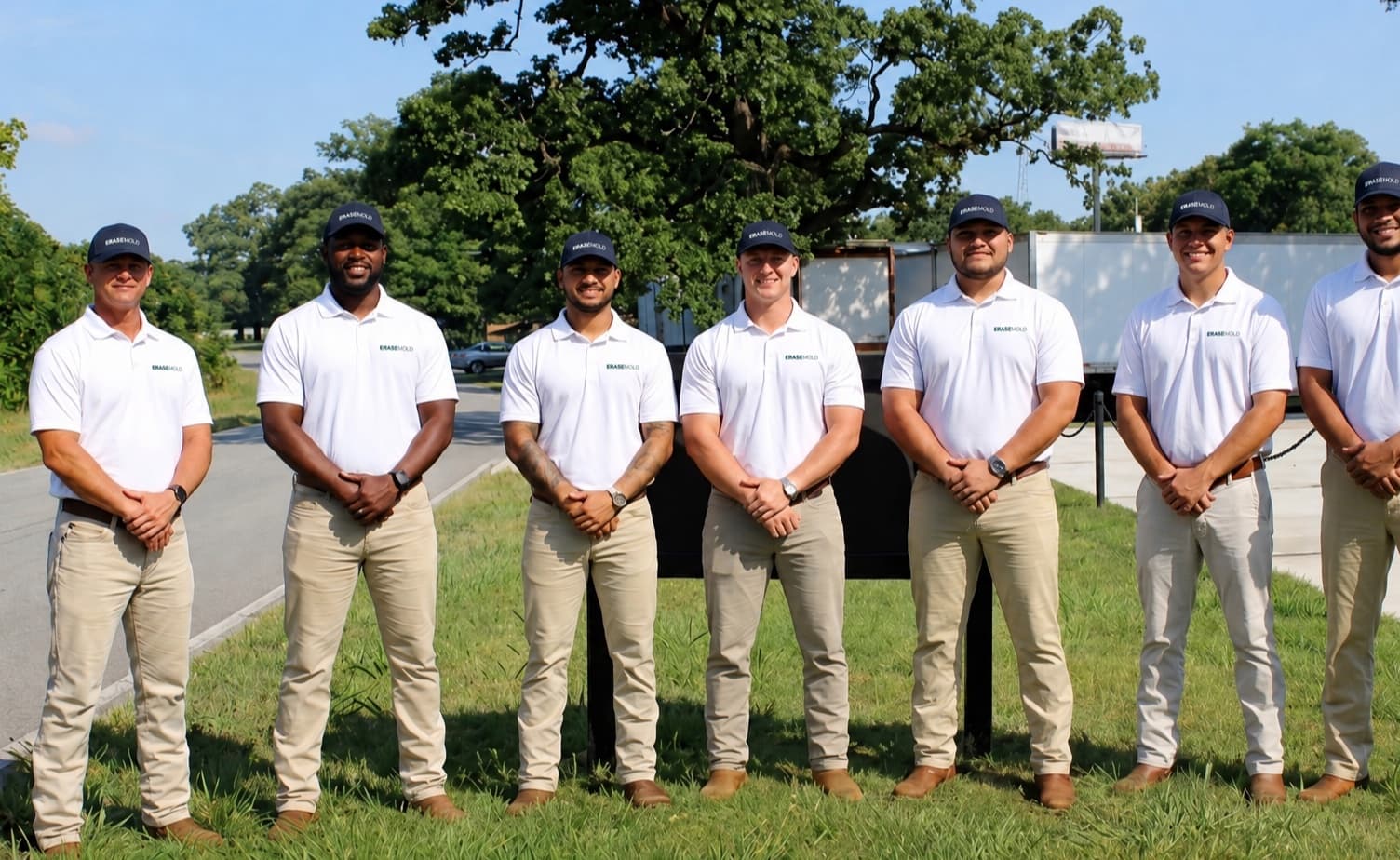
We are a local crew that does mold and water work the right way: find the moisture source, contain the area, and document the job so you know exactly what happened and why.
- Local to Metro Atlanta and its humid climate
- We treat the cause, not just the surface mold
- Containment-first work to protect the rest of your home
- Plain-language answers and documentation at every step
The damp crawl spaces and basements where mold takes hold are also where radon enters a home, so our sister company Erase Radon handles radon testing and mitigation for the same Metro Atlanta homes.
Request an InspectionFrequently Asked Questions
What does it mean to pass a clearance test?
Passing generally means the remediated area is visually clean and dry and that air sampling results are consistent with the outdoor baseline and a normal fungal condition. It does not mean zero spores, which is not achievable, but rather that the area has returned to normal conditions and the work appears complete.
Should the same company do both the remediation and the clearance?
Independent verification is generally considered the stronger practice, because the party checking the work is not the party who performed it. We are transparent about this. Where you want a fully independent clearance, we can structure the verification so the result stands on its own, read against the original baseline and scope.
When should clearance testing happen?
After remediation is complete and the area has been cleaned and fully dried, but before rebuilding or refinishing. Testing while the area is still damp or before final cleaning can produce results that do not reflect the finished work.
Cost and Insurance
What affects the cost?
Every situation is different, so we do not quote a price before we know what we are dealing with. Cost depends on the size of the affected area, how much material has to be removed, how hard the growth or moisture is to reach, the type and extent of containment needed, and any moisture repairs behind the problem. You get a written estimate after an inspection, so the scope and what is included are clear before any work begins.
Will insurance cover it?
It depends on your policy and the cause. Sudden and accidental events, such as a burst pipe, are more often covered, while gradual leaks, long-term seepage, neglected maintenance, and flooding are commonly excluded or need separate coverage, and many policies cap mold-related costs. We cannot promise what your policy will pay, so review your own policy and speak with your insurer about your situation. We can provide documentation of the conditions we find and the work performed to support a claim.
Related Services
Mold Removal and Remediation
Containment, removal of mold-affected materials, cleaning of salvageable surfaces, and correction of the moisture source behind the growth.
Learn more →Mold Testing and Air Sampling
Air sampling and surface testing to document mold conditions, compare indoor air to an outdoor baseline, and create a reference point.
Learn more →Mold Inspection
A thorough visual and moisture inspection to find where mold is growing and the conditions causing it.
Learn more →Mold Service Across Metro Atlanta
We provide post-remediation and clearance testing and the rest of our mold services throughout the Metro Atlanta area. Find help in your city or county:
- Mold removal in Atlanta
- Mold inspection in Sandy Springs
- Mold removal in Marietta
- Mold remediation in Roswell
- Mold inspection in Alpharetta
- Mold removal in Decatur
- Mold remediation in Smyrna
- Mold removal in Dunwoody
- Mold inspection in Brookhaven
- Mold removal in Johns Creek
- Mold remediation in Fulton County
- Mold removal in Cobb County
- Mold inspection in DeKalb County
- Mold removal in Gwinnett County
See all of the areas we serve across Metro Atlanta.
Concerned About Mold in Your Home?
Tell us what you are seeing or smelling and we will help you figure out the next step. Mold can begin to grow on damp surfaces within 24 to 48 hours, so it pays to look into it early.