
Metro Atlanta
Commercial Mold Remediation Across Metro Atlanta
Offices, retail, multi-family, and schools, remediated with containment that keeps your operation running and after-hours scheduling when you need it.
- Inspection that pinpoints the moisture source, not just the mold
- Containment-first work to limit the spread of spores
- A clear written scope and timeline before any work begins
Request an Inspection
Tell us what is going on and we will get right back to you.
Quick answer
Mold remediation for offices, retail, multi-family, and schools, planned to minimize business disruption with after-hours work available.
Mold in a commercial building creates pressures a home rarely does: tenants, customers, employees, and operations that cannot simply stop. The remediation itself follows the same sound principles used anywhere, but the planning has to account for keeping a business running and limiting disruption. We work in offices, retail spaces, multi-family and apartment communities, and schools, scoping each project around how the space is used, where containment can go, and when work can happen, including after hours and on weekends. The aim is to contain and remediate the affected areas properly while keeping the rest of the building usable and the impact on your operation as small as possible.
What Our Commercial Mold Remediation Includes
Remediation planned around your operation
We scope commercial projects around how the building is used. That means planning containment so unaffected areas stay open where possible, sequencing the work to limit disruption, and coordinating with facility managers, property managers, or ownership on timing and access.
After-hours and phased scheduling
For retail, offices, and occupied buildings, we can schedule work after hours, overnight, or on weekends, or phase it area by area, so customers, tenants, and staff are affected as little as possible.
Containment in occupied and multi-tenant buildings
In multi-family and commercial settings, keeping spores from migrating into occupied units and shared spaces is essential. We use containment, negative air pressure (air flows inward so spores cannot drift out), and HEPA filtration so remediation in one area does not become a problem for the rest of the building.
Thorough remediation and moisture correction
We contain the area, remove materials that cannot be cleaned, clean salvageable surfaces with HEPA filtration, and correct the moisture source. The goal is to physically remove the growth and fix the water, not to treat the surface and move on.
Documentation for owners, managers, and tenants
Commercial work often needs a clear paper trail. You receive documentation of the scope, the work performed, and, where useful, post-remediation verification, which is helpful for ownership, property management, lenders, and tenant communication.

How It Works
Site assessment and scope
We assess the extent of the mold and the moisture source, then build a scope of work that accounts for occupancy, building use, access, and the schedule that works for your operation.
Containment and protection
We isolate the work area with barriers and, where appropriate, negative air pressure and HEPA filtration so the rest of the building stays usable and spores do not spread to occupied space.
Remediation
Mold-affected materials that cannot be cleaned are removed, salvageable surfaces are cleaned and HEPA vacuumed, and the area is returned toward a normal fungal condition.
Moisture correction
We address the water source behind the growth, whether a roof or plumbing leak, an HVAC issue, or elevated humidity, so conditions no longer favor mold.
Documentation and verification
You receive records of the work, and where it adds value, post-remediation or clearance testing helps document that the area has returned to a normal condition.
Signs This May Be What You Need
- A musty smell reported by employees, tenants, or customers
- Visible mold or staining in offices, common areas, or units
- Tenant complaints tied to dampness or air quality
- Mold found during a building inspection or HVAC service
- Water damage from a roof, plumbing, or HVAC issue in a commercial space
- Recurring moisture problems across a multi-family property
Why Metro Atlanta Homeowners Call Erase Mold
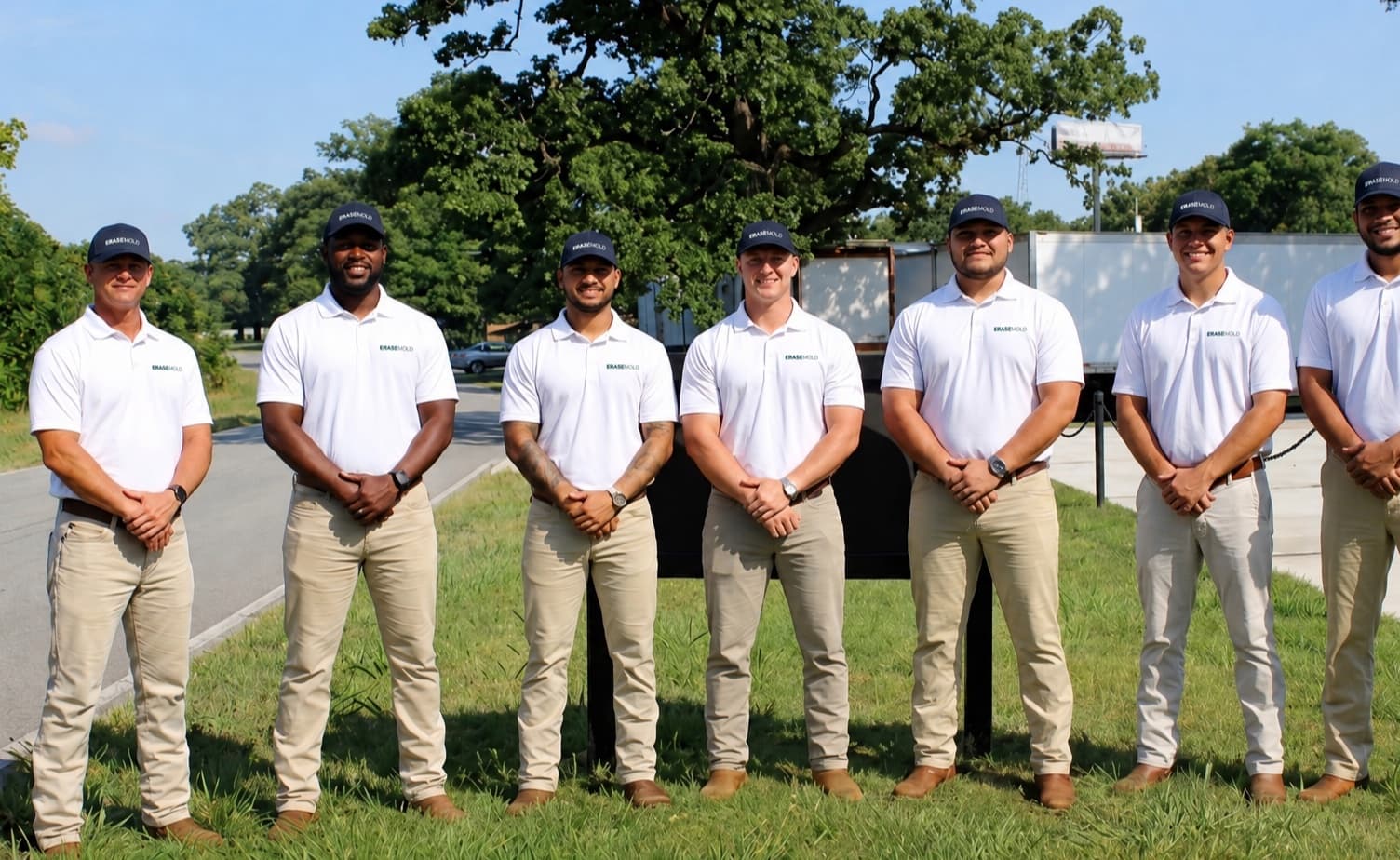
We are a local crew that does mold and water work the right way: find the moisture source, contain the area, and document the job so you know exactly what happened and why.
- Local to Metro Atlanta and its humid climate
- We treat the cause, not just the surface mold
- Containment-first work to protect the rest of your home
- Plain-language answers and documentation at every step
The damp crawl spaces and basements where mold takes hold are also where radon enters a home, so our sister company Erase Radon handles radon testing and mitigation for the same Metro Atlanta homes.
Request an InspectionFrequently Asked Questions
Can remediation be done without closing the business?
Often, yes. In many commercial settings we can contain the affected area so the rest of the building stays in use, and we can schedule work after hours or on weekends and phase it area by area. The right approach depends on the size and location of the mold and the layout of the space, which we determine during the assessment so we can plan around your operation.
Do you work in occupied multi-family and apartment buildings?
Yes. Occupied multi-family work calls for extra care to keep spores from migrating into other units and shared spaces, so we rely on containment, negative air pressure, and HEPA filtration. We also coordinate with property management on access and tenant communication and provide documentation of the work performed.
Is the company a licensed mold remediation contractor in Georgia?
Georgia does not license or certify mold remediation companies, so no company in the state can truthfully claim a Georgia mold license. Because the state does not regulate this work, it is worth asking any commercial provider about its training and approach before hiring.
How is commercial pricing determined?
Commercial cost depends on the size of the affected area, the materials involved, building access and occupancy, the scheduling required, and the moisture repairs needed. After-hours or phased work can affect the plan as well. We provide a scope and estimate after assessing the specific property rather than quoting a flat number sight unseen.
Will you document the work for ownership and tenants?
Yes. We provide records of the scope and the work performed, and where useful, post-remediation verification. This documentation supports communication with ownership, property managers, lenders, and tenants, and gives a clear account of what was done.
Cost and Insurance
What affects the cost?
Every situation is different, so we do not quote a price before we know what we are dealing with. Cost depends on the size of the affected area, how much material has to be removed, how hard the growth or moisture is to reach, the type and extent of containment needed, and any moisture repairs behind the problem. You get a written estimate after an inspection, so the scope and what is included are clear before any work begins.
Will insurance cover it?
It depends on your policy and the cause. Sudden and accidental events, such as a burst pipe, are more often covered, while gradual leaks, long-term seepage, neglected maintenance, and flooding are commonly excluded or need separate coverage, and many policies cap mold-related costs. We cannot promise what your policy will pay, so review your own policy and speak with your insurer about your situation. We can provide documentation of the conditions we find and the work performed to support a claim.
Related Services
Mold Removal and Remediation
Containment, removal of mold-affected materials, cleaning of salvageable surfaces, and correction of the moisture source behind the growth.
Learn more →Air Duct and HVAC Mold Removal
Removal of mold in ductwork, coils, and air handlers, with the condensation and humidity problems that feed it corrected.
Learn more →Water Intrusion & Mold Response
Help after a burst pipe, backup, or sudden leak, with the steps to take right away and a plan to contain and dry the area before mold takes hold.
Learn more →Mold Service Across Metro Atlanta
We provide commercial mold remediation and the rest of our mold services throughout the Metro Atlanta area. Find help in your city or county:
- Mold removal in Atlanta
- Mold inspection in Sandy Springs
- Mold removal in Marietta
- Mold remediation in Roswell
- Mold inspection in Alpharetta
- Mold removal in Decatur
- Mold remediation in Smyrna
- Mold removal in Dunwoody
- Mold inspection in Brookhaven
- Mold removal in Johns Creek
- Mold remediation in Fulton County
- Mold removal in Cobb County
- Mold inspection in DeKalb County
- Mold removal in Gwinnett County
See all of the areas we serve across Metro Atlanta.
Concerned About Mold in Your Home?
Tell us what you are seeing or smelling and we will help you figure out the next step. Mold can begin to grow on damp surfaces within 24 to 48 hours, so it pays to look into it early.