
Metro Atlanta
Mold Testing and Air Sampling Across Metro Atlanta
When it adds useful information, sampling documents conditions and gives you a reference point before and after work.
- Inspection that pinpoints the moisture source, not just the mold
- Containment-first work to limit the spread of spores
- A clear written scope and timeline before any work begins
Request an Inspection
Tell us what is going on and we will get right back to you.
Quick answer
Air sampling and surface testing to document mold conditions, compare indoor air to an outdoor baseline, and create a reference point.
Mold testing uses air and surface samples, analyzed by an accredited laboratory, to document the conditions in a building. Testing is not always necessary. There is no federal limit for indoor mold, and spores exist everywhere, so a result is most useful when it is compared to an outdoor baseline and read alongside what the inspection found. We recommend testing where it genuinely adds information, such as confirming whether elevated mold is present, comparing indoor to outdoor levels, or providing a before-and-after reference around remediation. Where it would not change the plan, we will say so rather than sell an unnecessary test.
What Our Mold Testing and Air Sampling Includes
Air sampling with outdoor comparison
Air samples capture airborne spores so the lab can identify and count them. Because mold spores are present outdoors too, we typically take an outdoor sample as a baseline. The comparison, rather than a single indoor number, is what makes the result meaningful.
Surface and tape-lift sampling
When there is visible growth or staining, a surface or tape-lift sample can confirm whether it is mold and what is present. This is often paired with air sampling to document a specific area.
Accredited laboratory analysis
Samples are sent to an accredited laboratory for analysis. You receive the lab report along with a plain-language explanation of what it means for your property, since raw spore counts are easy to misread without context.
Honest guidance on when not to test
For many small, clearly visible mold problems with an obvious cause, the EPA notes that sampling is generally unnecessary because the response is the same: remove the mold and fix the moisture. We will tell you when a test would not change the recommendation.

Signs This May Be What You Need
- You want to confirm whether elevated mold is present before deciding on work
- There is a musty smell but no clearly visible source
- You want a documented before-and-after reference around remediation
- A real estate transaction calls for documented conditions
- Someone in the home is sensitive to mold and you want conditions documented
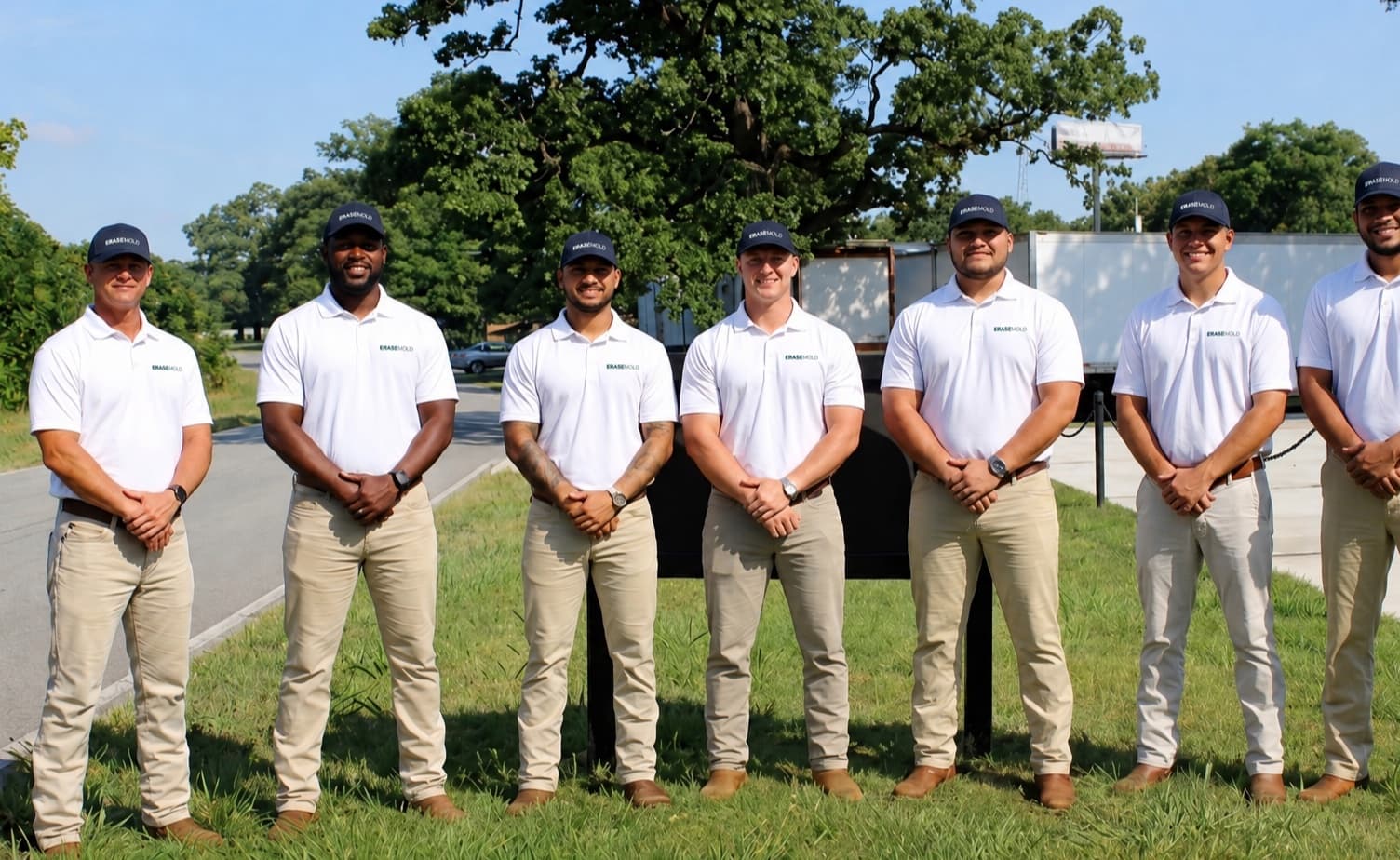
Why Metro Atlanta Homeowners Call Erase Mold
We are a local crew that does mold and water work the right way: find the moisture source, contain the area, and document the job so you know exactly what happened and why.
- Local to Metro Atlanta and its humid climate
- We treat the cause, not just the surface mold
- Containment-first work to protect the rest of your home
- Plain-language answers and documentation at every step
The damp crawl spaces and basements where mold takes hold are also where radon enters a home, so our sister company Erase Radon handles radon testing and mitigation for the same Metro Atlanta homes.
Request an InspectionFrequently Asked Questions
Is there a safe level of mold that testing can confirm?
No. There are no federal standards or established safe limits for indoor mold, and spores are a normal part of indoor and outdoor air. Testing is most useful as a comparison, indoor versus outdoor, and as a before-and-after reference, rather than as a pass or fail against a fixed number. Be cautious of any company that promises a specific safe spore count.
Should I buy a DIY mold test kit or an ERMI test instead?
Store-bought kits and ERMI tests can be hard to interpret and easy to misread. The EPA describes ERMI as a research tool that is not recommended for routine use in homes. Professional sampling with an outdoor baseline and lab analysis gives results that are more reliable and easier to act on.
Do I always need testing if I have mold?
Not necessarily. If mold is visible and the cause is clear, you often do not need a test to know it should be removed and the moisture corrected. Testing is most valuable when it answers a specific question, such as whether unseen mold is elevated or whether conditions improved after remediation.
Can you test before and after remediation?
Yes. Sampling before work documents the starting conditions, and post-remediation or clearance testing helps document that conditions have improved. To keep the verification independent, clearance is ideally read against the original baseline and the scope of work performed.
Cost and Insurance
What affects the cost?
Every situation is different, so we do not quote a price before we know what we are dealing with. Cost depends on the size of the affected area, how much material has to be removed, how hard the growth or moisture is to reach, the type and extent of containment needed, and any moisture repairs behind the problem. You get a written estimate after an inspection, so the scope and what is included are clear before any work begins.
Will insurance cover it?
It depends on your policy and the cause. Sudden and accidental events, such as a burst pipe, are more often covered, while gradual leaks, long-term seepage, neglected maintenance, and flooding are commonly excluded or need separate coverage, and many policies cap mold-related costs. We cannot promise what your policy will pay, so review your own policy and speak with your insurer about your situation. We can provide documentation of the conditions we find and the work performed to support a claim.
Related Services
Mold Inspection
A thorough visual and moisture inspection to find where mold is growing and the conditions causing it.
Learn more →Post-Remediation and Clearance Testing
Independent verification after remediation, using a visual review and air sampling to document that the area has returned to a normal condition.
Learn more →Mold Removal and Remediation
Containment, removal of mold-affected materials, cleaning of salvageable surfaces, and correction of the moisture source behind the growth.
Learn more →Mold Service Across Metro Atlanta
We provide mold testing and air sampling and the rest of our mold services throughout the Metro Atlanta area. Find help in your city or county:
- Mold removal in Atlanta
- Mold inspection in Sandy Springs
- Mold removal in Marietta
- Mold remediation in Roswell
- Mold inspection in Alpharetta
- Mold removal in Decatur
- Mold remediation in Smyrna
- Mold removal in Dunwoody
- Mold inspection in Brookhaven
- Mold removal in Johns Creek
- Mold remediation in Fulton County
- Mold removal in Cobb County
- Mold inspection in DeKalb County
- Mold removal in Gwinnett County
See all of the areas we serve across Metro Atlanta.
Concerned About Mold in Your Home?
Tell us what you are seeing or smelling and we will help you figure out the next step. Mold can begin to grow on damp surfaces within 24 to 48 hours, so it pays to look into it early.